



Instruments for Force Sensors
In modern force measurement and weighing systems, accuracy is non-negotiable. Whether you're operating truck scales, tank weighing systems, or precision dosing equipment, the reliability of your measurements directly impacts product quality, regulatory compliance, and operational efficiency. VPG Force Sensors provides state-of-the-art weight indicators & transmitters, load cell junction boxes and calibrators designed to eliminate measurement errors, ensure system consistency, and deliver the precision your business demands.
Our comprehensive solutions address critical challenges faced by manufacturers and industrial operations: combining signals from multiple load cells without drift, maintaining measurement accuracy across varying environmental conditions, and ensuring quick, efficient calibration without costly downtime.

Complete Range of Indicators, Calibrators and Junction Boxes
Indicators
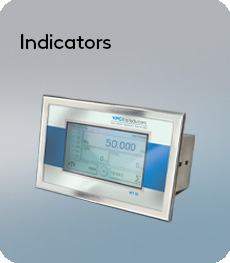
Indicators are precision instruments that display, record, and communicate force or weight measurements from load cells in real time. They are primarily used for monitoring, data collection, and compliance, and may trigger an action on the system level or control a basic process (e.g. activate a relay).
Indicators are ideal for applications where accurate force or weight visibility, reliable data recording, and seamless integration with monitoring or reporting systems are required. They display measurements in real time via LED or LCD, support transaction history and data logging for audit trails, and offer serial communication such as RS-232 and RS-485, along with connectivity to printers, networks, and supervisory systems. They are designed to meet regulatory requirements such OIMLR76 legal for trade NAWI and CE and UL & FCC .
Junction Boxes
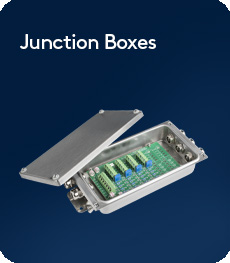
Junction boxes play a critical role in systems that use multiple load cells or force sensors. They serve as a central connection point, combining signals from several sensors into a single, stable output for the indicator or controller.
Junction boxes provide signal summation from multiple load cells, typically ranging from two to twelve or more, and enable signal trimming so each sensor contributes equally to the total measurement. They also ensure stable power distribution and protect electrical connections within sealed enclosures designed for harsh industrial environments. By equalizing sensor outputs, junction boxes eliminate corner-load errors and help maintain consistent accuracy across the entire measurement system. In addition, protect electrical systems from over voltage and line surges which can occur during lightning or power interruptions. They are designed either for analog load cells [mV/V] or digital load cells [e.g. RS485]
Calibrators
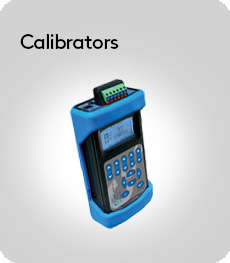
Calibrators are used to verify and maintain the accuracy of force sensors, load cells, and the complete measurement chain. Over time, factors such as temperature changes, vibration, and mechanical stress can cause measurement drift.
Calibrators enable verification of sensor accuracy and early detection of measurement drift caused by temperature changes, vibration, or mechanical stress. They support portable field testing without removing equipment from service, while also offering high-precision measurement with microvolt-level resolution. Traceable calibration documentation helps support ISO 9000 and ISO 376 requirements, ensuring long-term measurement reliability and regulatory compliance.
INSTRUMENTS QUESTIONS ANSWERED
What is the difference between a weighing indicator and a controller?
A weighing indicator displays, records, and communicates measurement data, while a controller includes these functions and actively controls external equipment using programmable setpoints and relay outputs.
When do I need a junction box in a force measurement system?
A junction box is required whenever multiple load cells or force sensors are connected to a single indicator. It ensures proper signal summation, trimming, and stable measurement accuracy.
Why is signal trimming important in multi-load-cell systems?
Signal trimming equalizes the output of each load cell so that uneven load placement does not affect overall measurement accuracy.
How often should force sensors and load cells be calibrated?
Calibration frequency depends on the application. High-volume or safety-critical systems may require quarterly calibration, while many industrial systems are calibrated annually.
Can calibrators be used in the field as well as in laboratories?
Yes. Portable calibrators are designed for field verification, while benchtop calibrators are used for high-precision laboratory testing with traceable documentation.
Do environmental conditions affect instrument selection?
Yes. Temperature, moisture, electrical interference, and installation environment should all be considered when selecting indicators, junction boxes, and calibrators.
Need help? Our application engineers provide expert guidance—no project is too small or too large for VPG Force Sensors.